

My name is Marie-Hélène Verdier.
In French, Marie-Hélène is difficult to pronounce owing to its length and the juxtaposition of open vowels. Even my folks cannot manage. At home, I answer to Marie-Lou.
I am from peasant stock, as my last name indicates. ‘Verdier’ was the old French name given to foresters during medieval times on account of the color of their uniform. ‘Vert ’ means green. The suffix ‘ier ’ denotes an occupation. Over time, the ‘t’ softened into a ‘d’. To my knowledge, my family counts no aristocrats, except perhaps for the predictable bastard (there were rumors about a great-grandmother). No one in our ancestry has any claim to any fame.
I was born February 17, 1964 in Albi, a small city located in the South of France. My folks, on both sides, have roamed that small geographical area for countless generations. The surrounding hills and valleys are littered with cousins of the umpteenth degree I have yet to meet. Inbreeding is more than a possibility.
By chance my parents came around when, for the first and only time in French history, poor people could climb the social ladder. With hard work, they managed to break the old cycle of poverty. The blacksmith’s son became a doctor, the peasant’s daughter a nurse. That and the solid public education afforded French kids during the 1970s held for me the promise of a comfortable life in the South of France.
But life had other, faraway plans.
Shortly before I turned 18, when I was still clueless about myself, I fell in love with a girl from Texas. Carol was attending high school in the south of France as a foreign exchange student. Her first French family was not a good fit. Mine stepped in at my sister’s urging and Carol was quickly adopted.
When I first laid expectant eyes on her, I felt the proverbial coup de foudre – a real jolt, as if struck by lightning. Carol had gorgeous blue eyes and a movie star smile. She was the most beautiful girl I had ever seen.
Carol quickly returned my feelings. Still, it took us months to put two and two together. We met in September but first kissed the following April. When her parents invited me to spend a year in Texas, I did not hesitate. I was very shy, and knew not a word of English. But love will make the meekest of us cross oceans in a canoe and a heartbeat.
The year in Texas was not a big success. The first six months, I struggled with language isolation and a serious heartbreak when Carol fell for one of her classmates. He was a boy, I could not compete.
Eventually my status got restored to first consort and things improved until Carol’s mother caught us sleeping naked in my single bed. It was 1982, neither side of the Atlantic was gay friendly. France had reluctantly decriminalized homosexuality the year before. In the US there was talk about a new gay plague. Carol’s mother stopped talking to me for the miserable rest of my Texas stay.
There was a silver lining. That year I paid my first visit to New Orleans. It too was love at first sight. And also life changing.
I returned to college in the south of France. Carol and I did not think our relationship would outlive Texas. But once separated, we missed each other unbearably. She was a freshman at Tulane University in New Orleans, and she had a place of her own. She asked me to join her.
My parents took the news with a stiff upper lip. In 1984, there was no internet, long distance phone calls cost a fortune, and I was not much of a writer. From now on, they would see me only a couple of times each year. My father, choking tears, sent me out the door with the French version of Rudyard Kipling’s words: ‘‘Tu seras un homme, mon fils.’’
You will be a man, my son.
I was in New Orleans for eight years. The first seven months, I worked as a hostess for the European Community Pavilion at the infamous 1984 New Orleans World’s Fair. In the spring of 1985, I started college at Loyola University. In 1988, I got a B. A. in English and Political Science. After a brief stint as a French and English teacher for Redeemer High School, a Catholic institution that did not survive Hurricane Katrina, and a few months working for a sleazy local attorney, I attended Loyola Law School on full scholarship. I received my doctorate degree in 1992.
The New Orleans years were fun, free, and crazy. They made up for the childhood I did not have. I was a serious, intense little girl. All that heavy luggage was left behind when I crossed the Atlantic.
In France, I was awkward and invisible. In America, I became attractive. The tomboy turned into a feminine woman with long dark hair, pretty brown eyes (with the right make-up), high cheekbones, and a slightly aquiline nose on a nice face. I played the French card with outfits and attitudes from the home country. I looked different, remarkable. I was still painfully shy and insecure, but I hid it under an aloofness that, if not always cool, was excused and expected given my countrymen’s reputation.
All this helped me come to terms with the complication of being gay. In New Orleans where everyone goes to the beat of their own drum, it was easier to accept that, since boys were not an option (I had tried), girls would do just fine. France still had a long way to go.
For eight “straight” years, New Orleans became my sanctuary. The relationship with Carol fizzled, others took over in a heartbeat and ended equally fast. My love for the city endured.
In 1992, law degree in hand, I was finally ready to go home. France was a place I no longer knew after the political and social whirlwinds of the 1980s. I was curious to get reacquainted. It was also an exciting time to return. The Berlin Wall down, Europe suddenly turned into a fabulous playground. Last but not least, I had a hefty student debt to repay and no work permit in the US.
I settled in Paris. The next 25 years, I worked for top American and British firms. Because the law was not my mistress and I was not married to my job, I did not climb the corporate ladder. But I paid my bills, and it paid off. In 2017, thanks to a few lucky real estate investments in Paris, I was ready to quit my job and live off the money. Meanwhile, I had bought a dilapidated shotgun house in a challenging but slowly gentrifying part of New Orleans where I planned to live part time as soon as I could retire. After many years, New Orleans was still the place my heart called home.
In the fall of 2017, I made it to my beloved shotgun house on Marais Street, a stone throw from the French Quarter. I had turned the work page and was ready for a new chapter.
There was, of course, the proverbial price to pay. I had left behind a string of sorry relationships, at best complicated, at worst, toxic. The last one, with the lovely P.K., had been a disaster. P.K. looked like a rock star without the ego. She had given it all, me whatever I could. After five years of uncharacteristically angry behavior, I was losing my soul. I had ended the relationship with the diagnosis, or the excuse, of a heart too damaged to care for someone else’s. It was hard to be single for the first time of my life, but I was at peace. I gambled that my love for New Orleans, and my few good friends in the city, could fill the void.
A scarce month into this, I received a call from my sister.
Marie-Dominique was in Idaho for a photo shoot. She had run into a friend in the town of Sandpoint and wanted to make introductions.
‘‘You will like her, trust me,” she only said.
—
I had reason to believe my sister’s words.
Marie-Dominique, a.k.a. “Do”, was born barely a year and a half after me from young parents unable to work out the rhythm method, an ironic accomplishment for an aspiring doctor and a registered nurse. They had three unplanned kids before my father was 25 and out of medical school. My older brother, Pierre, was first. I came next, then Do, in rapid succession. Because I was the first girl in a litter of five — the planned ones, Frédéric and Marie-Agnès, would come post-pill a few reasonable years later — I was the caretaker of my siblings, especially Do. We grew up sharing a bedroom and clothes, fighting a lot but also protecting each other, too often from Pierre’s wrath when, as teenage years hit, he transformed overnight into an unfriendly older brother. Despite different personalities and affinities, Do and I became close and dramatically impacted each other’s lives.
Hers changed entirely when she came to visit me in New Orleans during my student years. She met Scott, a musician fresh out of college who played street piano in the French Quarter. Scott was a fantastic performer and drop-dead gorgeous. My beautiful sister immediately saw the potential. After a few years of predictable romantic turbulence, she and Scott married in New Orleans, had a little girl (Sara Hélène, my godchild, born very premature), then moved 3,000 miles away to Sandpoint, Idaho. It was the only place Scott felt he could safely raise a family.
He had a point.
Located between Seattle in the West and Toronto in the East, Sandpoint sits on a huge lake with 250 miles of gorgeous coastline surrounded by an awesome stretch of Rocky Mountains. Its best kept secret is a ski resort only 20 minutes away from downtown, with a wealth of pristine snow that stretches the season from Thanksgiving to Easter. The ski runs are almost always empty, unlike overcrowded Europe. There is no line at any lift, ever.
To Scott, Sandpoint was, if not paradise, a chance at purgatory for someone regularly in and out of hell. He moved Do and baby Sara there in 2000. Leah-Marie came two years later, at full term, picture perfect. Their lives, however, were anything but. Right after Leah’s birth, Do was diagnosed with advanced cervical cancer. Then sweet Sara developed Hodgkin’s lymphoma when she was 11. Through it all, Scott struggled with severe opioid addiction.
For all these sad reasons, I visited often. And because of them, I was not fond of Sandpoint. Do and I wanted to live close to each other, but I could not put Sandpoint’s ominous dark clouds (it rains a lot there) on my future life map. It was also too far away from my beloved, sunny New Orleans. Do, who felt very settled, would try to entice me to move nearby. My lack of enthusiasm, and frequent derogatory comments about the town and its long, grey winters, made it clear it would take a miracle. But, loath to disappoint, I added a caveat: ‘If you find me a girlfriend there…’
This did not fall on deaf ears.
Do first spotted Laura Wahl in 2006. Laura was working as a graphic designer for a small company in town. She was the art director of Sandpoint Magazine and Do one of the best photographers around. They met for a job.
Do immediately knew she had a hit. Unfortunately, Laura was married with children.
A few years later, Laura told Do of her divorce and of switching sides to someone named Nancy.
“I did not know that about you,” was my sister only comment.
In November, 2017, right before Thanksgiving, Do bumped into Laura. “How are things with Nancy?” she inquired to Laura’s sad face.
That evening, Do sent the life changing text.
‘‘Laura, meet my sister Marie-Hélène. Marie-Hélène, this is Laura. Take it from there.’’
—
Laura and I started texting between New Orleans and Sandpoint, half a country and two time zones apart. A few days later, a deluge of messages under the bridge, we were in love.
I had seen pictures on Facebook: a beautiful woman with dark hair, dark eyes, an athletic and tan body. There was notably a dreamy one of Laura riding a galloping horse, her smile infectious, her wild hair blowing in the wind. She completely looked the part of the fearless American cowgirl of my fantasies. Would the flesh and bones version live up to it?
On December 4, we found the courage to video.
When I first looked at Laura on the small, deforming screen of my phone, I had a start. Her face seemed familiar.
Amazingly, she felt the same.
Four days later, I asked her to marry me.
‘Yes!’, she answered in the next heartbeat.
We had yet to meet.
That finally happened December 15. On my way to Sandpoint, I flew through Denver and stayed the night at Do’s (ironically, the girlfriend challenge was moot – my sister had moved to Colorado). Over dinner, I declared I had found the meaning of my life. The next morning, I boarded the plane without an ounce of nervousness. As I disembarked in Spokane, I did have, true to self, a panic attack when I came back to my senses. Five minutes later, Laura arrived, and I was out of my mind again. We fell into each other’s arms, locked into each other’s bodies, and I finally belonged in my life.
—
I quickly resolved to move in with Laura and her two daughters. Mason was a tall and lanky 17 year old as fair and blonde as her mother was dark. Sage, at 10, was a mini version of Laura, if possible even prettier. Both showed the promise of great beauty and charisma. Like their mother, they were also fearless and trusting. They welcomed me with open arms. `
There was a lot of shuffling back and forth between New Orleans, Sandpoint and France. By the end of July, I knew I would call Sandpoint home, at least until Mason’s high school graduation the following summer.
In early September, Laura and I became the proud owners of a lovely little cabin in the woods. By the end of October, after a month of renovations, we relocated there. In December, we rescued Mela, a puppy chosen from the local animal shelter. By the turn of the new year, 2019, having checked all the boxes of a bona ‘Fido’ gay family, Laura and I started to imagine a life together all the time. After 25 years working for the same company, she was more than ready to call it quits. That suited me, provided I could feed my new family. A radical migration south became the obvious choice.
I had business in New Orleans. A few months earlier, I had put my Paris flat on the market to buy a stately New Orleans mansion. My friend Daniel had purchased it a couple of years earlier and just finished renovations. His girlfriend, Lauren, ran a small but successful bed and breakfast in my shotgun house on Marais Street. I hoped to do the same with Daniel’s mansion. The big house was located at 2235 Bayou Road in the heart of a prestigious Creole neighborhood. A B&B in its quaint upstairs attic space would yield a good return. My little family could comfortably live in the larger space downstairs.
Laura, who was no fool, endorsed the plan with enthusiasm.
(From Chapter One)
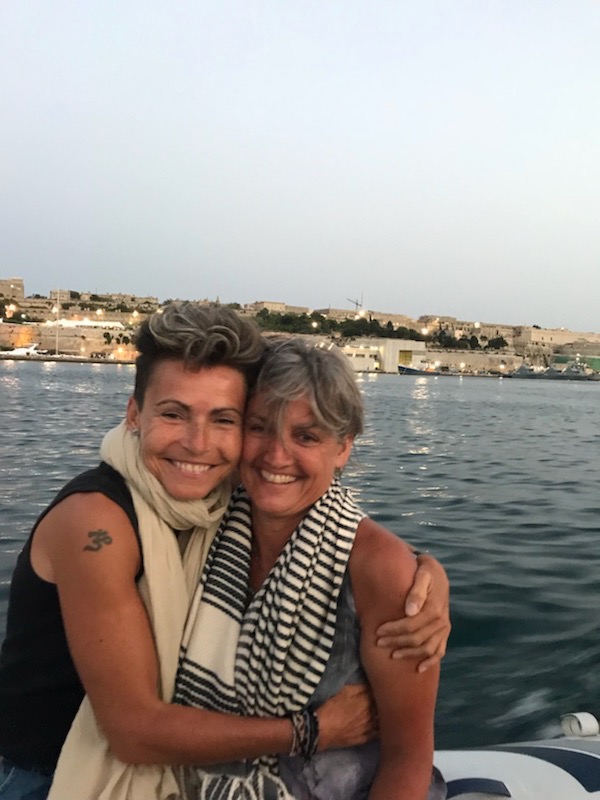
Lou and Laura, Greece, 2018 our first year together, in this lifetime.
 English